I hit delete on my fifth attempt at writing that email. The one asking for a chance to present my idea to potential investors. My finger hovered over the keyboard as that familiar voice in my head whispered, “Who do you think you are?”
Self-limiting beliefs. They’re the invisible walls we build around ourselves – often so gradually that we don’t even notice they exist until we try to move beyond them.
This week, we’ve been talking about breaking through those inner barriers. And today, we’re exploring specific techniques from Napoleon Hill’s work that can help us overcome obstacles that seem to block our path forward.
When Your Brain Becomes Your Biggest Roadblock
Let’s be real. The most difficult obstacles aren’t usually external. They’re the stories we tell ourselves about what we can and cannot do.
Napoleon Hill spent decades studying successful people, and he discovered something fascinating: the most successful individuals weren’t necessarily the most talented, educated, or privileged. They were the ones who mastered their thoughts.
Hill found that our beliefs act like invisible prison guards, keeping us safely confined to what we think is possible. These guards can be particularly strict when we try to overcome obstacles standing between us and our dreams.
One client we worked with – a brilliant woman who wanted to start her own consulting business – kept telling herself, “I’m not ready yet. I need more experience.” She’d been saying that for seven years.
That’s not preparation. That’s procrastination dressed up as responsibility.
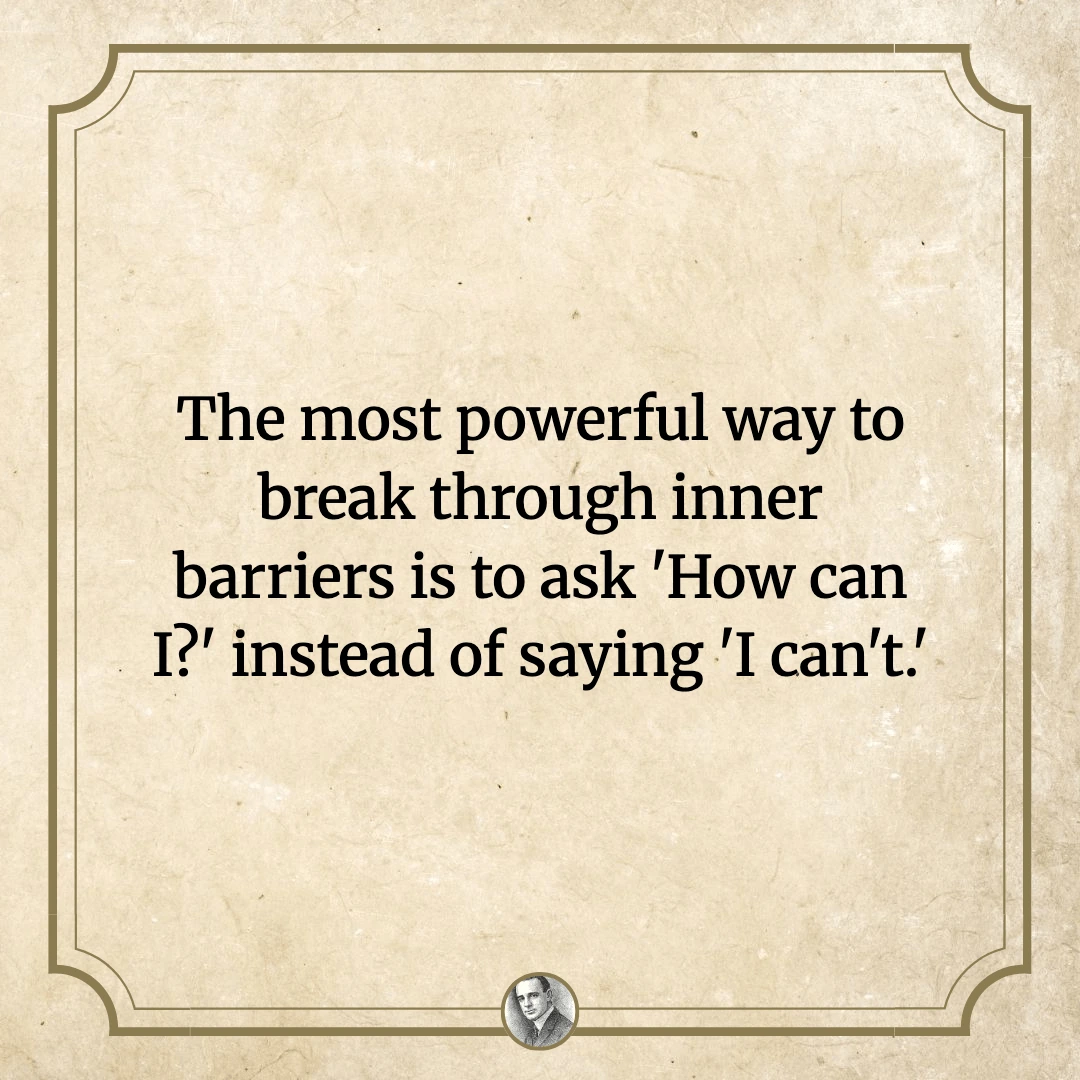
Technique #1: Replace “Impossible” With “I’m Possible”
Napoleon Hill wrote, “Whatever the mind can conceive and believe, it can achieve.” But this isn’t just a cute saying for refrigerator magnets. It’s a practical mental strategy.
When you hit an obstacle, your first thought might be “I can’t do this.” Hill would suggest immediately replacing that thought with “How can I do this?”
This simple shift transforms your mind from a problem-focused machine into a solution-generating powerhouse.
Try this: The next time you face something that seems overwhelming, write down the obstacle. Then write “How can I…” and complete the sentence. Don’t stop with one answer. Write at least five possible approaches.
This technique works because it acknowledges the obstacle while refusing to give it the final word. Your brain loves solving puzzles, and when you present a “how” question, it gets to work finding answers instead of dwelling on problems.
Turn Your Definite Major Purpose Into a Daily Shield
Hill emphasized having a “definite major purpose” – a crystal-clear vision of what you want to achieve. When you face obstacles, this purpose isn’t just a nice-to-have; it becomes your armor.
Obstacles look different when viewed through the lens of purpose. What seems impossible for a vague goal becomes merely challenging for a deeply meaningful one.
Sharon and I talk about this all the time. When we started our business, we had countless technical issues with our first website. Frustrating? Extremely. But because we were crystal clear on why we were building it – to help people transform their relationship with money and success – those obstacles became puzzles to solve rather than reasons to quit.
Create a one-sentence statement of your definite major purpose. Make it specific and emotionally powerful. Place it somewhere you’ll see it daily – especially when working through challenges. When obstacles appear, read it aloud and ask yourself: “Compared to this purpose, how significant is this obstacle really?”
The perspective shift can be immediate.
Technique #3: Activate Your Mastermind Alliance to Overcome Obstacles
One of Hill’s most powerful concepts is the Mastermind Alliance – the idea that two or more minds, working in perfect harmony toward a definite goal, multiply each other’s power exponentially.
When facing obstacles, most people make a critical mistake: they isolate themselves.
Imagine trying to move a heavy boulder alone. Nearly impossible, right? But with three or four people helping, suddenly it’s manageable. The same principle applies to mental and emotional obstacles.
Who are the two or three people you could call right now who would help you think through your challenges? Not people who will just sympathize, but those who will help you find solutions and hold you accountable?
If you don’t have these people in your life yet, finding them might be your most important immediate goal. Join groups, attend workshops, or reach out to mentors who align with your purpose. A properly formed mastermind becomes your obstacle-busting team.
Fear is Just Excitement Without Breath
Hill identified fear as one of the most common obstacles to success. But he didn’t suggest eliminating fear – he recommended transforming it.
Physiologically, fear and excitement create almost identical responses in your body. The difference? Your interpretation and your breathing.
When you feel that flutter in your stomach before tackling something challenging, your default might be to label it “fear” and retreat. Hill would encourage you to relabel it as “excitement” and lean in.
Next time you face an obstacle that triggers fear:
1. Take three deep, slow breaths 2. Say aloud: “I’m excited about this challenge” 3. Ask yourself: “What’s the worst that could happen, and could I handle that?” 4. Remind yourself of past obstacles you’ve overcome
I tried this before my first major speaking engagement. Hands shaking, heart racing – the whole deal. After three deep breaths and reframing my nervousness as excitement, I didn’t become fearless, but the fear became manageable enough that I could move forward.
Build Your Obstacle Muscle Through Persistence
“Effort only fully releases its reward after a person refuses to quit.”
This Hill quote highlights what might be his most important principle for overcoming obstacles: persistence.
Hill studied more than 500 of the most successful people of his time and found that persistence was the common denominator. Not talent. Not luck. Not connections. Persistence.
Think of persistence like a muscle. Each obstacle you push through strengthens this muscle, making the next challenge easier to overcome.
Many people quit just before their breakthrough moment. Hill called this the “failure period” – the time when obstacles seem most insurmountable, right before success arrives.
Create a “persistence journal” where you document each obstacle you face and overcome. When new challenges appear, review your journal to remind yourself of your track record of persistence. This builds confidence that you can overcome whatever you’re facing now.
Moving Beyond the Invisible Walls
These five techniques from Napoleon Hill’s success principles aren’t just theoretical. They’re practical tools that have helped countless people break through obstacles – especially those self-limiting beliefs we’ve been exploring all week.
Remember that the obstacles you face today are developing the strength you’ll need for tomorrow’s opportunities. As Hill wrote, “Strength and growth come only through continuous effort and struggle.”
So which technique will you try first? The one that resonated most deeply is probably the exact one your mind needs right now.
Maybe start with the simplest: turning “I can’t” into “How can I?” and see what solutions your amazing mind generates when you give it the right question to answer.
The obstacles don’t disappear. But with Hill’s principles, you develop the mindset to see them differently – not as walls, but as stepping stones to the success you’re creating.