Last night while scrolling through my bank account, my heart dropped. Again. That familiar tightness in my chest showed up right on schedule – the one that appears whenever I have to face my financial reality. Maybe you know exactly what I’m talking about.
Financial anxiety isn’t just worrying about money. It’s that full-body experience that hijacks your thoughts, disturbs your sleep, and makes you avoid looking at your accounts altogether. It’s exhausting. And frankly, it’s stealing our peace in ways we don’t even realize.
We’ve spent this entire week exploring financial freedom and wealth consciousness. But we can’t truly build wealth if we’re paralyzed by financial fear. So today, let’s tackle the emotional side of money head-on.
Why Our Brains Get Stuck in Money Panic Mode
Money concerns trigger our primitive brain in powerful ways. When we worry about not having enough, our brain interprets this as a survival threat – no different than if we were being chased by a predator. This activates our stress response, flooding our system with cortisol and adrenaline.
This explains why financial stress feels so overwhelming. Your brain isn’t distinguishing between “I might not make rent” and “I might be eaten by a lion.” Both register as danger.
The problem is that while this stress response is helpful for immediate physical threats, it’s terrible for solving complex financial situations. When we’re anxious, our prefrontal cortex – the thinking, planning part of our brain – literally goes offline. We can’t think creatively or see opportunities.
This creates a nasty cycle: money stress → panic response → reduced thinking capacity → poor financial decisions → more money stress.
We’ve got to break this loop first before any manifestation techniques or wealth mindset work can really take hold.
Do This Immediately When Money Panic Hits
I learned this technique from a financial therapist (yes, that’s a real profession) during a particularly rough patch when I couldn’t even open my bills without feeling sick.
When you feel that wave of financial anxiety building:
1. Stop whatever you’re doing and take three deep breaths, extending the exhale longer than the inhale 2. Place your hand on your heart or stomach 3. Say out loud: “This is my brain trying to protect me. I am safe right now in this moment.” 4. Ask yourself: “What’s the very next small step I can take?”
This isn’t just feel-good fluff. This sequence actually interrupts the amygdala hijack happening in your brain and brings your thinking center back online.
The goal isn’t to magically make your financial problems disappear. The goal is to create enough emotional space that you can actually think clearly about them instead of spiraling.
The Weird Connection Between Financial Anxiety and Your Past
Something fascinating happens when we dig into our money fears – they’re rarely just about money.
Our relationship with money starts forming before we can even understand what money is. We absorb our parents’ attitudes, witness their arguments, feel the tension when bills arrive, or experience the celebration when money flows in.
These early experiences create what psychologists call “money scripts” – unconscious beliefs that drive our financial behaviors today.
For example, if you grew up with unpredictable finances – maybe your family had money one month and struggled the next – you might now hoard money even when you have plenty. Or if you watched your parents work themselves to exhaustion for money, you might have developed a belief that wealth always requires suffering.
To overcome financial anxiety once and for all, we need to identify and rewrite these scripts.
Try this: Write down your earliest memory involving money. Was it positive or negative? How might that experience be influencing your feelings about money today?
Sometimes just seeing the connection between past and present breaks the spell. “Oh, I always panic when my account drops below $1,000 because that’s what happened right before we lost our house when I was 10.” That awareness alone creates space to respond differently.
Your Three-Day Reset to Overcome Financial Anxiety
Let’s get practical. Here’s a three-day reset anyone can do to start shifting from financial anxiety to financial peace:
Day 1: Financial Reality Day Take a deep breath and gather ALL your financial information – bank statements, credit card bills, loans, investments, everything. Calculate your exact net worth (assets minus debts). Yes, this might be uncomfortable, but clarity is the first step to peace. You can’t navigate what you can’t see.
Day 2: Gratitude + Possibility Day Make two lists: everything you’re grateful for financially (even small things count – “I always have enough for coffee”) and all the ways money could potentially come to you. Get creative with the second list – include raises, side gigs, investments, unexpected gifts, anything possible in this universe.
Day 3: Single Action Day Choose ONE small money action that would make you feel more in control and do it. Maybe it’s setting up automatic savings of $5/week, canceling one unused subscription, or calling about a lower interest rate. The size doesn’t matter – taking control does.
This three-day reset works because it combines clear-eyed reality with possibility thinking and concrete action – three elements that directly counteract financial anxiety.
The Silent Wealth Blocker Most People Miss
There’s something almost no one talks about when it comes to overcoming financial anxiety and building wealth: financial shame.
Shame is different from guilt. Guilt says, “I made a mistake with money.” Shame says, “I AM a mistake with money.” And shame thrives in secrecy.
When we’re ashamed of our financial situation, we hide it. We don’t ask questions. We don’t seek help. We pretend we know more than we do. And this secrecy becomes the perfect environment for anxiety to grow stronger.
I remember sitting in a meeting once where everyone was discussing investment strategies, nodding along like I understood what a “backdoor Roth conversion” was, when I had absolutely no clue. My shame kept me ignorant.
Here’s the truth: Most people are confused about money. Even wealthy people make mistakes. There’s no moral value to having or not having financial knowledge. It’s just information you either have or haven’t learned yet.
To truly overcome financial anxiety once and for all, we must release financial shame. Start talking about money with trusted friends. Ask “stupid” questions. Admit what you don’t know. The relief is immediate.

What Actually Creates Financial Peace?
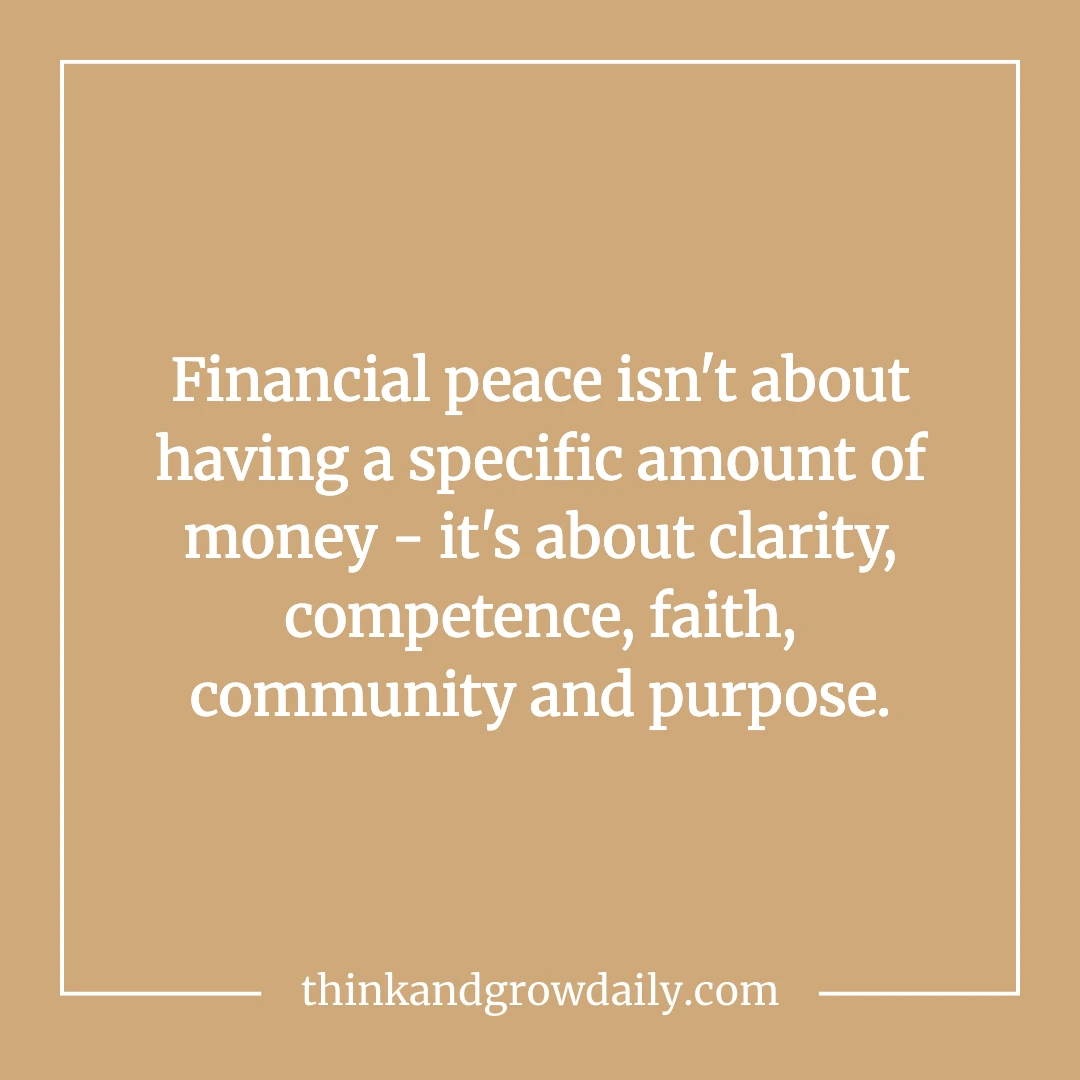
After years of working with these principles, we’ve discovered that lasting financial peace isn’t actually about having a specific amount of money. We all know wealthy people who still worry constantly about their finances.
Instead, financial peace comes from a combination of:
1. Clarity – Knowing exactly where you stand financially 2. Competence – Having basic skills to manage what you have 3. Faith – Believing in your ability to handle whatever comes 4. Community – Having people you can talk honestly with about money 5. Purpose – Using money as a tool for what truly matters to you
Each of these elements can be developed regardless of your current financial situation. Even taking small steps in these areas creates a noticeable shift in anxiety levels.
As we close our week on financial freedom, remember this: Money is energy. Anxiety constricts energy. Peace allows it to flow. The work you do to overcome financial anxiety isn’t just making you feel better – it’s actually removing the biggest block between you and the wealth you desire.
What’s one small step you’ll take today?