I once caught myself staring at my reflection in my laptop screen at 2:37 AM, stuck in a loop of the same old ideas. Nothing new coming through. Just recycled thoughts spinning in a hamster wheel of limitations. It wasn’t writer’s block – it was mindset blockage.
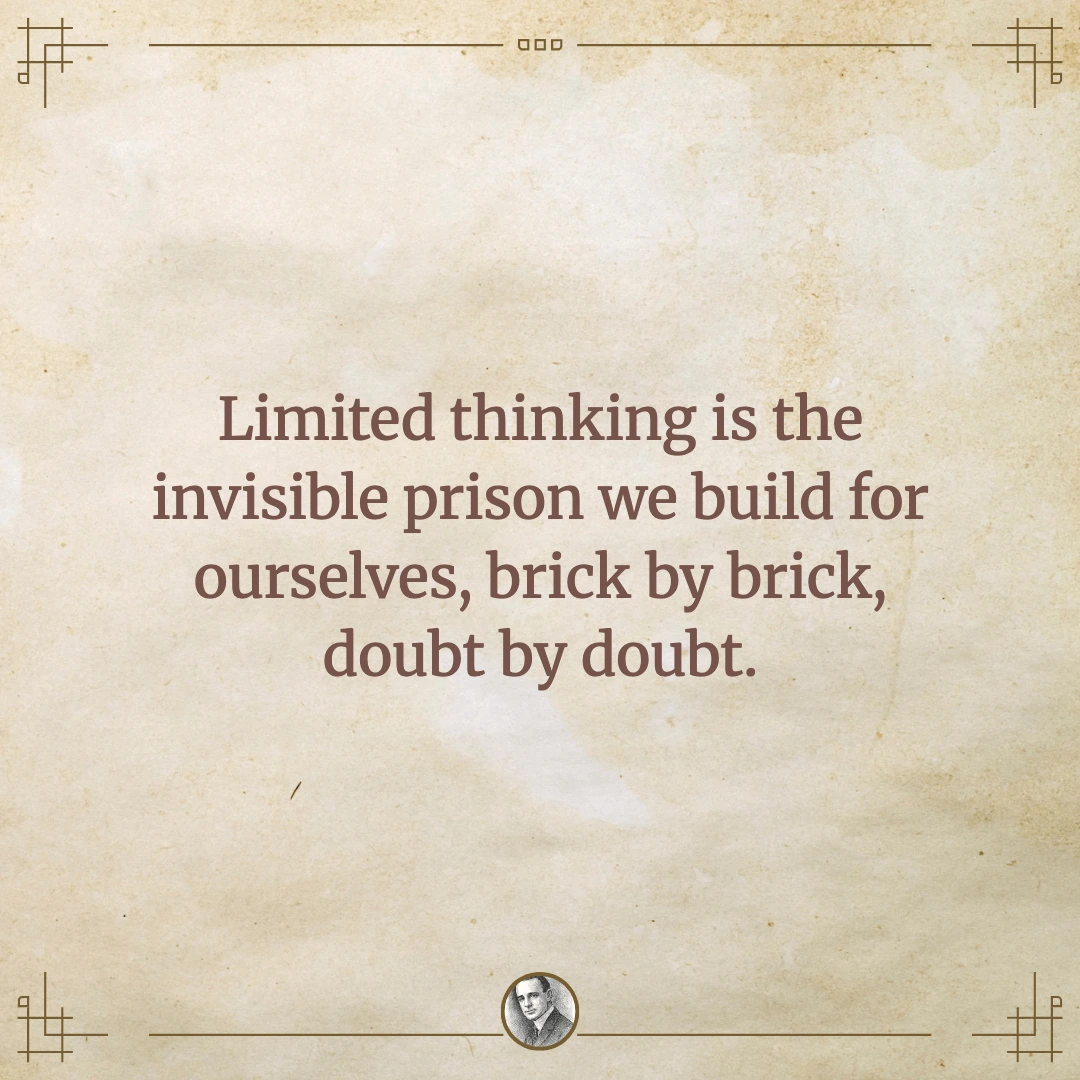
Limited thinking is the invisible prison we construct for ourselves. It’s that voice that says “impossible” before we even try. The mental box we don’t realize we’re sitting in until we try to stand up and hit our head.
Creative vision requires dismantling these walls we’ve built – some from childhood, some from last Tuesday’s disappointment, and others from sources we can’t even identify anymore. The funny thing about these mental barriers? They’re completely made up. Not one of them is actually real.
Your Brain Is Playing Tricks On You
Limited thinking sneaks up on us like a bad habit. One minute we’re dreaming big, and the next we’re talking ourselves out of even trying. Our brains are wired for caution – keeps us safe, sure, but also keeps us small.
We all have these mental shortcuts that developed over time. They’re called cognitive biases, and they’re basically your brain’s way of making quick decisions without overthinking. Helpful when dodging traffic. Not so helpful when deciding if you can start a business, write a book, or manifest that dream relationship.
The worst part? These shortcuts become invisible. We don’t think, “Oh, I’m currently experiencing a limiting belief.” We just think, “That’s not possible for someone like me.”
You might be experiencing limited thinking right now without even realizing it. Are certain opportunities “not realistic”? Do you dismiss ideas with “that would never work”? Have you decided certain dreams are for “other types of people”?
These thoughts aren’t facts. They’re just thoughts. And thoughts can change.
What Would Napoleon Hill Say About Your Mental Barriers?
Napoleon Hill spent his life studying successful people, and he discovered something profound: the most significant difference between extraordinary achievers and everyone else wasn’t talent or opportunity. It was their ability to think beyond current circumstances.
Hill wrote: “Whatever the mind can conceive and believe, it can achieve.” Simple words that hit like a sledgehammer against our walls of limitation.
He would likely look at our limited thinking patterns and point out how they’re just bad mental habits. Nothing more. Nothing less.
The good news? Habits can be broken. Mental patterns can shift. And today – right now – we can start that process.
1. Challenge Your “I Can’t Because” Statements
Pull out a notebook real quick. Write down three things you want but believe you can’t have. Now next to each one, write “because…” and finish the sentence.
“I can’t start my own business because I don’t have enough experience.” “I can’t find a partner because I’m too busy.” “I can’t change careers because I’m too old.”
See what you did there? You’ve just identified your limited thinking traps. Those “because” statements aren’t universal laws. They’re just stories you’ve been telling yourself.
For each one, ask: “Is this absolutely true? Could someone else in my exact situation achieve this? What if this limitation didn’t exist at all?”
When I did this exercise myself, I realized half my “because” statements were based on things that happened years ago that weren’t even relevant anymore. And the other half? Just assumptions I’d never actually tested.
The Mirror Technique That Actually Works
This might sound a little weird at first, but stay with me.
Every morning this week, stand in front of a mirror and look yourself in the eye. Choose one area where you’ve felt limited and speak a new possibility out loud. Not as an affirmation, but as a question.
“What if I could easily learn the skills I need?” “What if finding the right relationship is simpler than I’ve made it?” “What if changing careers at 45 is the perfect timing?”
Questions open doors that statements keep shut. When you ask “what if” questions, your brain automatically starts searching for answers instead of defending its limitations.
The mirror part matters because it’s harder to lie to yourself or brush off the question when you’re looking at your own face. Try it for a week. It feels awkward at first (I nearly abandoned the whole thing after day two), but by day four, something shifts.
3. The 10X Vision Exercise
Limited thinking loves reasonable goals. It thrives on “realistic expectations.” So let’s mess with it a bit.
Take whatever goal or dream you’ve been contemplating and multiply it by ten. Seriously. Want to make an extra $1,000 a month? Think about making $10,000 instead. Want to write one book? Imagine a ten-book series. Planning a weekend getaway? Visualize living in that destination for a month.
This isn’t about actually pursuing the 10X version (though why not?). It’s about stretching your mental boundaries. When you force yourself to envision something way beyond your current thinking, your original goal suddenly seems less intimidating.
The magic happens when you ask: “What would I have to believe to make the 10X version possible?” Those beliefs are the exact opposite of your limited thinking.
Finding Evidence That Dismantles Your Limits
Limited thinking survives on selective attention. We notice all the evidence that supports our limitations and ignore anything that contradicts them.
Time to flip the script. For each limitation you’ve identified, spend 10 minutes finding evidence that it’s not true. Look for:
– People who started with less than you and succeeded – Times in your life when you overcame similar obstacles – Examples that directly contradict your “because” statements
Keep a running document of this evidence. Add to it whenever you discover something new that challenges your limited thinking. Review it when those old thought patterns creep back in.
I started doing this last year, and my document has over 30 entries now. Some are stories of people I admire, others are personal experiences I’d forgotten about. Each one chips away at those mental walls.
5. The One Week No-Limits Experiment
This last approach is simple but powerful. For exactly seven days, commit to living as if your limitations don’t exist.
Don’t announce it to anyone. Don’t make a big deal about it. Just silently decide that for one week, you’ll act as though your limiting beliefs are all completely false.
What would you say yes to? What would you attempt? How would your decisions change? What opportunities would you notice that you typically filter out?
The purpose isn’t to make dramatic life changes in a week. It’s to notice how much your limited thinking has been directing your choices and perceptions without you realizing it.
After the week ends, write down what you learned. What felt different? What possibilities opened up? What remains challenging?
Sometimes limited thinking dissolves not through analysis but through direct experience that contradicts it.
The Real Work of Creative Vision
Overcoming limited thinking isn’t a one-and-done achievement. It’s daily practice. These five approaches aren’t magical solutions – they’re tools for an ongoing process.
The reason we focus so much on dismantling limited thinking is that creative vision can’t flourish in confined spaces. Your ability to manifest new possibilities depends first on your ability to see them as possible.
Start with just one of these approaches today. Pick whichever one resonates most. The others will be waiting when you’re ready for them.
Remember: the walls of limitation exist only in your mind. And what exists in mind can be transformed by mind. Your creative vision is already there, waiting for you to clear away the mental clutter that’s been hiding it from view.